

LLMs are typically trained on large amounts of web data and that data inevitably contains personal names. Data protection regulations like the GDPR make removing unnecessary personal data (e.g. names) a legal requirement. But this creates a real problem: scrubbing the name “Michelangelo” from training data to protect a private individual also removes a reference to one of history’s greatest artists, potentially degrading the model’s performance on general knowledge tasks. The question of which names to remove and which to keep turns out to be far more nuanced than it first appears.
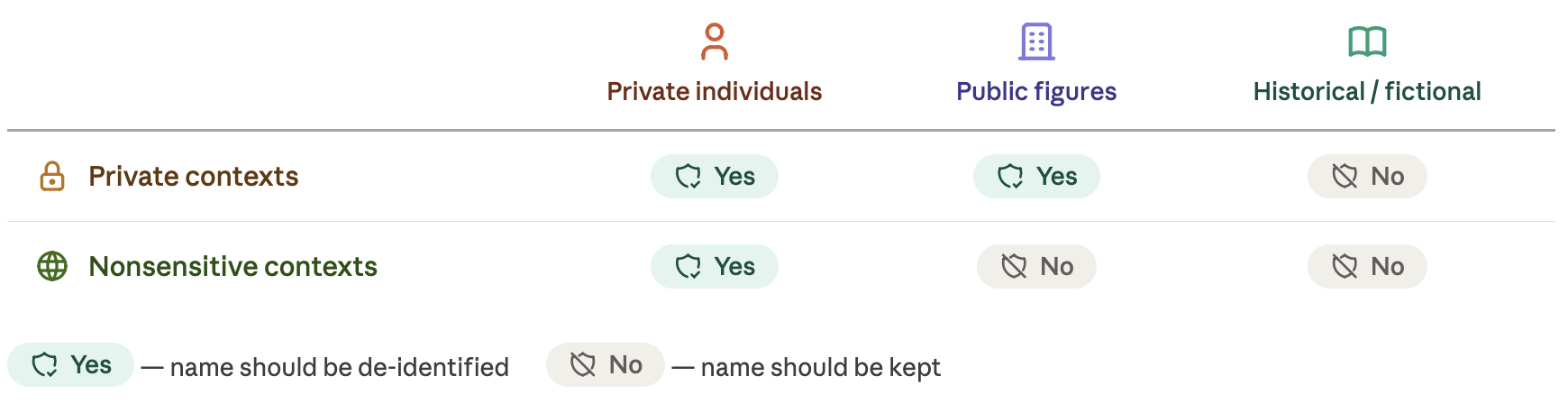
We present VEIL (Value-Preserving Entity Identification Limitation), the first benchmark designed specifically for context-aware personal name de-identification decisions in LLM training data. Rather than treating all names equally, VEIL frames the decision around two dimensions: the type of person (private individual, public figure, or historical/fictional character) and the context in which their name appears (private or nonsensitive). These categories are grounded in the Council of Europe’s guidelines on privacy in the media – the same framework that governs how journalists decide what to disclose and what to protect. A famous politician’s name in a news article about their policy decisions is very different from the same politician’s name in a story about their family life; and VEIL captures exactly that distinction.
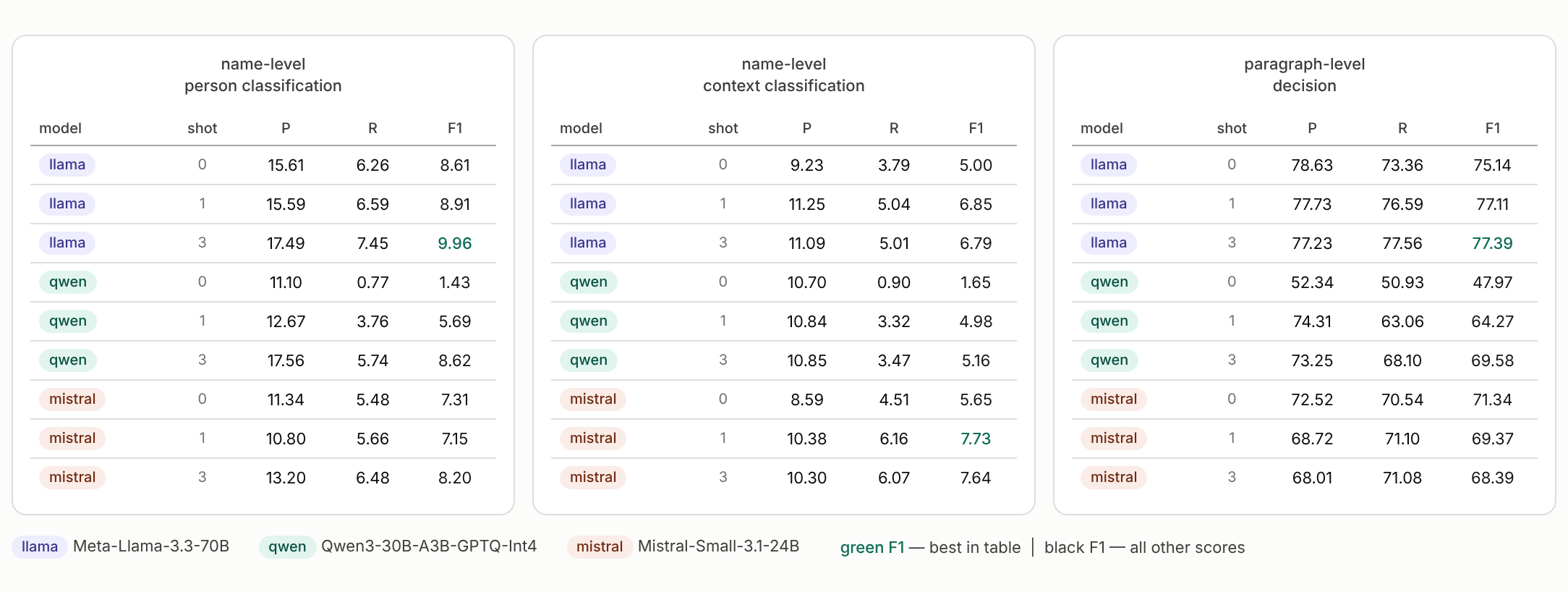
The benchmark contains 1,083 paragraphs annotated with 2,438 personal names, drawn from the DCLM corpus and supplemented with synthetically generated examples for the conditions where real data would itself constitute a privacy risk. We evaluated three state-of-the-art on-premise LLMs – Meta-Llama-3.3-70B, Mistral-Small-3.1-24B, and Qwen3-30B-A3B-GPTQ-Int4 – on the task, finding that even capable models struggle significantly at the name level (best F1: 9.96), while paragraph-level decisions are more tractable but must be interpreted against a strong majority baseline of 74.6 %. Few-shot prompting consistently outperformed zero-shot across all models and tasks.
VEIL is available under a CC-BY-4.0 license at https://huggingface.co/datasets/IIS-NLP/VEIL and can serve as a foundation for building de-identification systems that balance privacy compliance with data utility; a trade-off that will only become more important as regulations like the GDPR increasingly shape how LLM training data is handled.
Author: Shadi Rastegar from Fraunhofer IIS