

Modeling the radio reflectivity of radar objects is essential for ISAC (integrated sensing and communications) channel simulations. ISAC is a new technology in which radar sensing and communication share common infrastructure and radio resources. It is particularly relevant as radio resources become scarce, making ISAC a major new topic for future 6G communication networks discussed in 3GPP (3rd Generation Partnership Project).
When considering radar sensing in mobile communication systems, the channel model must be extended by models that represent the environment geometrically and accurately model electromagnetic interactions. In particular, the reflectivity of the targets of interest must be modeled accurately. This is crucial to distinguish between different targets such as cars, pedestrians, cyclists, UaVs (unmanned aerial vehicles), etc. and to evaluate detection, tracking, and classification algorithms.
The reflectivity of a target depends on its geometrical shape and physical material. Consequently, it also depends on the bistatic angle, including the illumination angle and the scattering angle, as well as the radio frequency. Thus, reflectivity must be represented as a multidimensional function. Because of this complexity, deterministic simulation models are computationally complex.
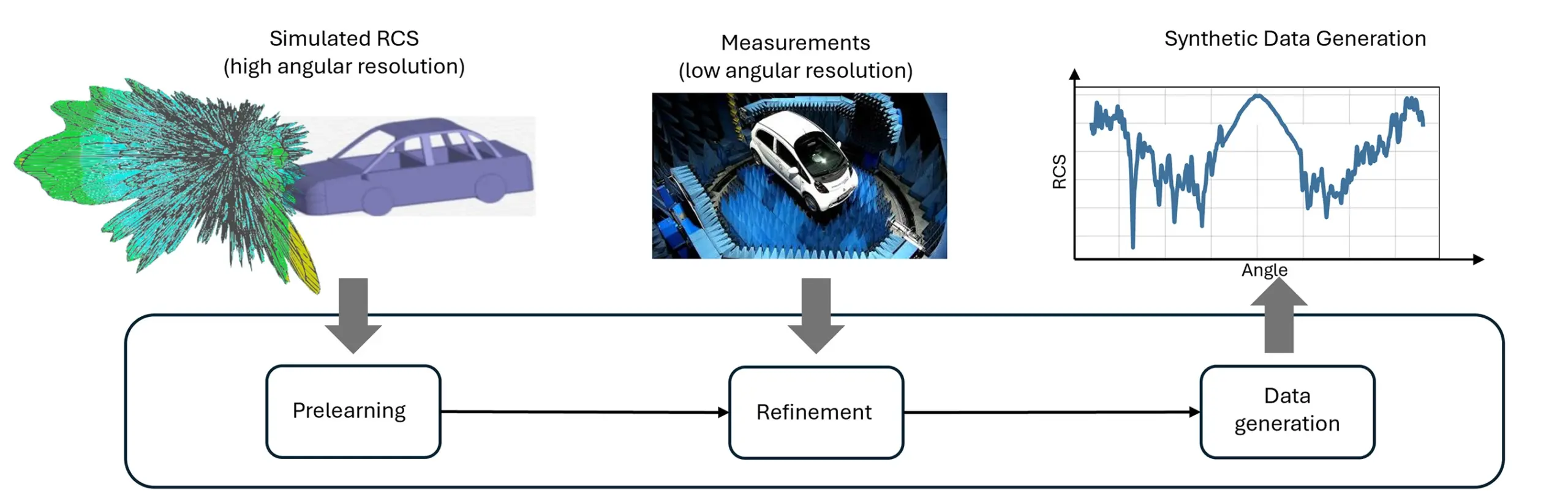
This is where we can benefit from AI (artificial intelligence)-based models. This study investigates how AI-based models can be trained on high-quality simulated and measured reflectivity data to represent reflectivity efficiently and accurately. While simulations can provide a high-resolution dataset to learn the fundamental reflectivity characteristics of a target type (e.g., a car) at a particular frequency, the model can be refined using sparse measurements of a real object.
Author: Carsten Smeenk, from Fraunhofer IIS